Generate and inspect panels
Turn the current mould and layout into flat cut panels, then check their shape, allowance, labels, and any reported warnings before exporting.
Generate the current design
Start generation
Choose Panels > Generate Panels or press G while focus is outside a form field. The status bar changes to generating panels....
The app sends a fresh snapshot of the effective measurements, cloth, and construction settings to the backend whenever that content has changed. It then requests the selected layout and the current session's Apply postprocess setting.
Read the result
On success, the status changes to panels: N. The new panels, seam allowance, and warning list replace the previous set. A typical preloaded Albin Vega 27 gennaker currently produces 44 Tri-radial panels.
On failure, a dismissible panel error: banner appears and the status bar shows the same message. No replacement panel set was produced; correct the reported input, backend, rate-limit, or panel-budget problem and try again.
Open the viewer
Choose Panels > View Panels or press P. This command is disabled until a generated set exists. Select Back or press Escape to return to the design.
Backend and account boundary
The 3-D mould and seam preview are calculated in the browser, but flattening panels needs the backend and will fail while it is unreachable. Signing in is not required for generation. An unsigned guest can currently generate up to 55 panels per request; the error message suggests a larger maximum panel width if the design would exceed that limit. Exporting has separate account rules.
Apply the optional postprocess
Apply postprocess is under Panels > Layout. It is off by default, lasts only for the current browser session, and applies when you next choose Generate Panels. The pass straightens declared-straight edges, smooths the others, and writes the result into the returned flat panels used by the viewer and panel exports.
Experimental output
The current in-app help reports roughly 1–2% area loss on Traditional and Mitre layouts. The option does not change the browser-side 3-D seam or colour preview. Generate and inspect a fresh panel set after changing it.
Know when to generate again
Generated panels are a cache, not part of the saved design file. Starting or opening a design clears them. The app also clears the panels, warnings, and allowance after changes to:
- measurements, rig, edge shape, or profiles;
- fullness;
- cloth or construction settings;
- the selected layout.
Those changes disable View Panels and the panel-based export commands until you generate again. Changing panel colours does not invalidate the generated geometry.
Current display-mode behaviour
In the current app, switching among 3-D, 2-D, and Heatmaps, or changing the lightweight preview heatmap, also clears the generated set. The status bar can still show the old panels: N text even though View Panels is disabled. Generate again before inspection or export.
The experimental panel postprocess is applied only during generation. When enabled, the returned postprocessed cut edges are what this viewer and the panel exports use. The browser-side 3-D layout and colour preview do not change.
Read the panel viewer
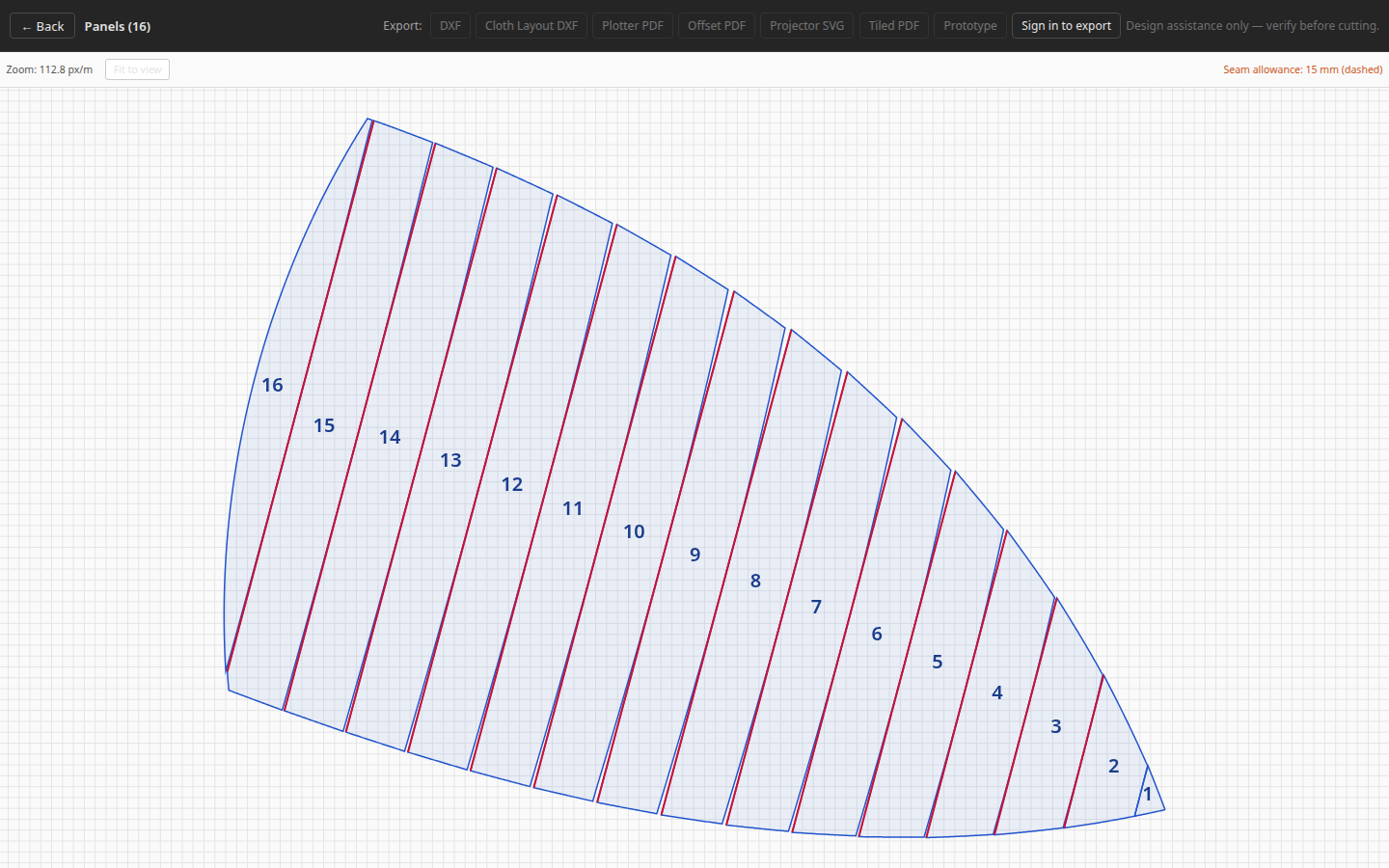
Generated panels are arranged by their seam-neighbour topology for inspection; this is not a nested cloth-roll layout.
- Back and export actions
- Zoom, fit, and allowance
- Flattened panels and display numbers
The viewer places panels beside their seam neighbours in an “orange peel on a table” arrangement. The gaps help expose the flat pieces; they are not a cutting plan or a promise that the panels fit the cloth roll.
| What you see | Meaning |
|---|---|
| Light grid | 100 mm spacing. It disappears when zoomed too far out to remain legible. |
| Blue outline and pale fill | The cut boundary of each returned flat panel. |
| Red edge | An edge the panel generator declares straight. A red label does not guarantee the experimental postprocess moved it. |
| Seam-allowance note | The configured allowance in millimetres. The current note says “dashed”, but current generated responses do not supply a per-panel allowance path, so no dashed outline is drawn. |
| Blue number | A short, contiguous display number. Its ordering depends on the selected layout. |
| Warning list | Non-fatal generation warnings grouped by code, count, panel identifiers, and value range. It appears only when the response contains warnings. |
The blue display number is the convenient reference printed on the canvas and in several exports. Warning details can instead name a topology-stable panel identifier; it is not necessarily the same text as the display number.
What the viewer does not show
The current viewer does not draw warp-direction arrows, match marks, seam IDs, or paired-seam annotations. Those details may be present in a specific export; do not infer them from the on-screen outline. Use the export overview to choose the output you need.
Pan, zoom, and reframe
- Drag with a mouse, pen, or touch pointer to pan.
- Use the mouse wheel or trackpad scroll gesture to zoom around the pointer.
- Read Zoom: … px/m for the current screen scale. It is a display readout, not a print scale.
- Select Fit to view to place the complete set back inside the canvas.
The export toolbar at the top uses this generated set. It links directly into the export workflow without changing what is drawn on the canvas.