Profiles and fullness
Shape the sail’s horizontal sections one height at a time, or use Fullness to make every interior section deeper or flatter together.
Keep the four shape layers separate
| Layer | Primary controls | What it changes |
|---|---|---|
| Edge shape | Round, Opening, Position | The luff, foot, and leech outline and out-of-plane bow |
| Section profile | Depth, Draft, Entry, Exit | One horizontal cross-section of the sail |
| Whole-sail fullness | Fullness | Every interior section’s Depth by the same multiplier |
| Mould loft | Mould algorithm, smoothing, foot stretch | How the section curves become one continuous surface |
This page owns section profiles and whole-sail fullness. See Edge shape and twist and Mould controls for the other two layers.
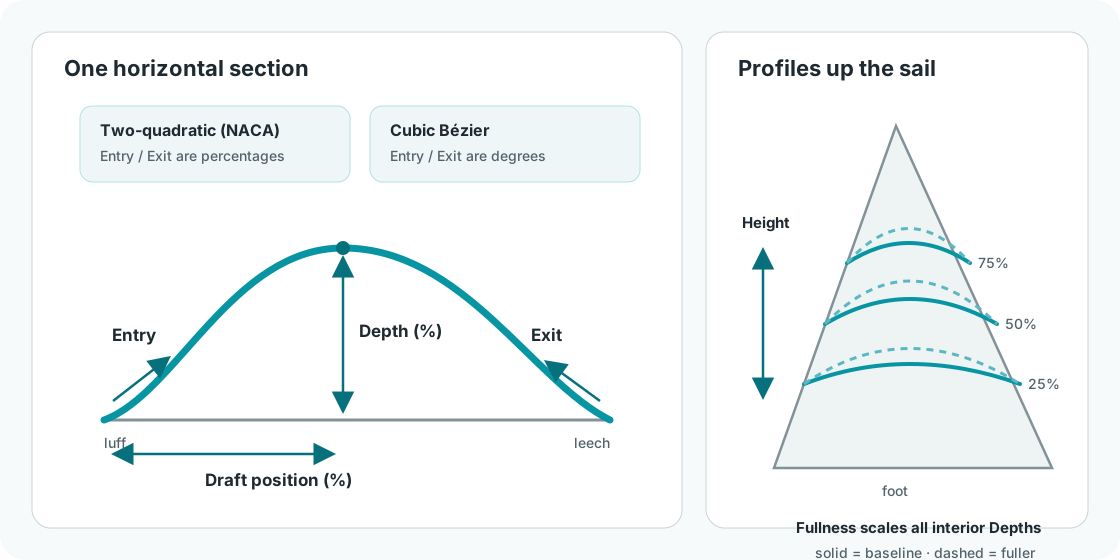
A profile shapes one horizontal section. Fullness scales the Depth of all interior profiles together.
Edit a section in Profile Edit
Switch the Shape card to Profile Edit
Select Profile Edit at the top of the right-hand Shape card. The sail displays selectable section lines.
Select a height
Click a section line on the sail or choose a chip under Heights. The foot chip is always present. The 100% head boundary is not shown as an editable profile height.
New designs normally start with interior heights at 10%, 25%, 50%, and 75%. A new Code 0 starts at 25%, 50%, and 75% instead.
Checkpoint
The chosen chip is highlighted and the card heading changes to Foot or H = …%.
Adjust the selected section
Use Depth for the amount of camber and Draft for the chordwise position of that camber. The second ± slider makes a fine Depth adjustment around the coarse value.
For an interior height, Depth runs from 0–50% in 0.5% coarse steps. The fine slider runs from −1.5 to +1.5 in 0.1 steps. Draft runs from 10–90% in whole-percent steps.
Choose the section algorithm
All current sail types start with Two-quadratic (NACA), but you can switch either way at any time:
Choice Controls in Profile Edit Range Observable difference Two-quadratic (NACA) Entry, Exit 5–95% The maximum Depth and Draft position are held directly; Entry and Exit change the two sides of the section Cubic Bézier Entry, Exit 0–89° Entry and exit tangent angles shape a softer single curve; its deepest point can shift from the requested Draft position With Two-quadratic selected, the full Sail Shape table calls the same shape controls Luff round (%) and Leech round (%). Profile Edit presents them as Entry and Exit so moving right has the same “sharper entry” direction as Cubic Bézier.
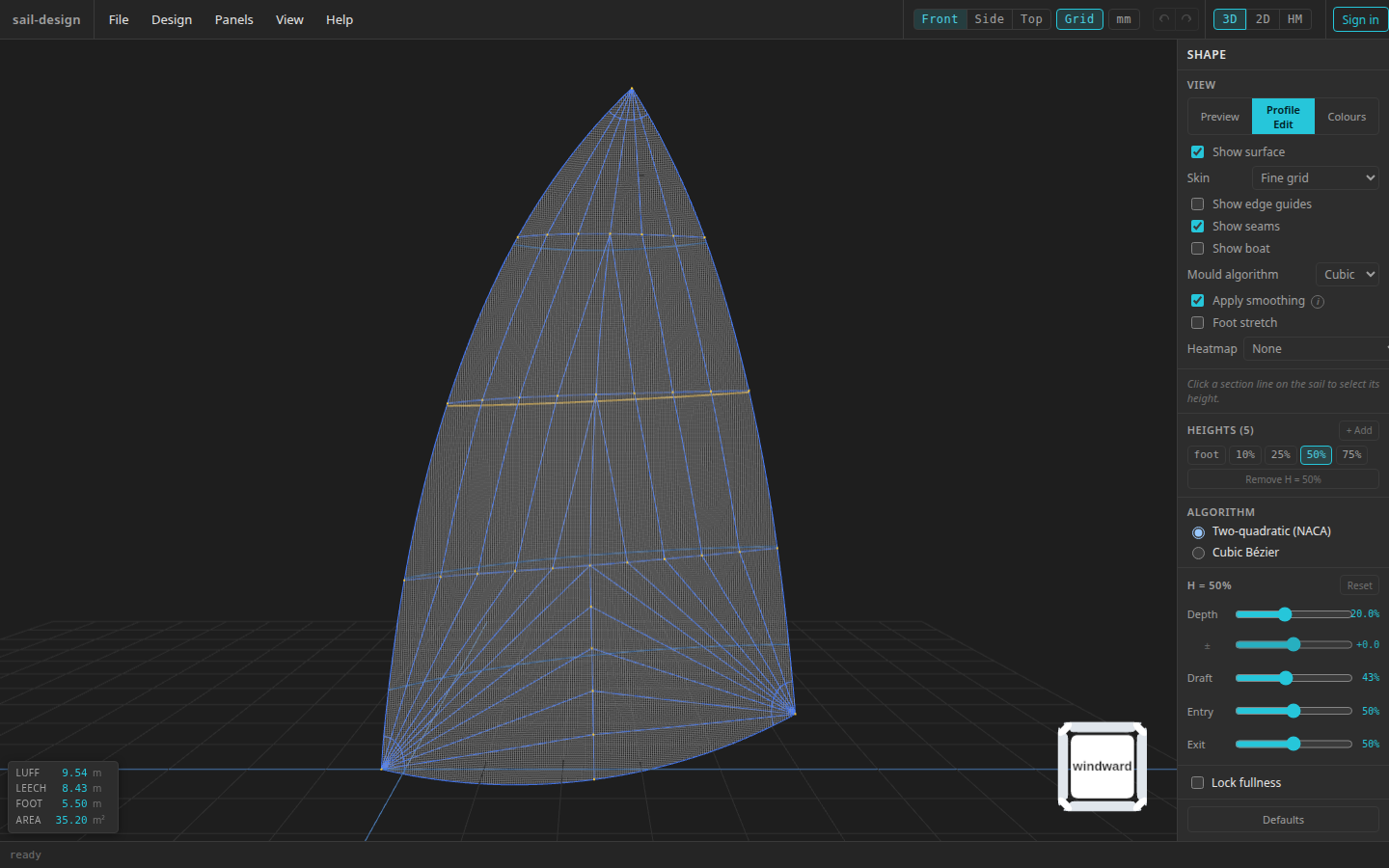
Profile Edit on the preloaded Albin Vega 27 gennaker example, with H = 50% selected.
- Selected section on the sail
- Height chips
- Section algorithm
- Selected-section controls
Shape the foot profile
The foot chip deliberately uses its controls differently because the foot is an edge, not an interior horizontal section:
| Foot control | Range | Same setting elsewhere |
|---|---|---|
| Depth | 0–20% plus the same ±1.5 fine control | Foot > Opening (%) in Design > Sail Shape > Edge curves |
| Draft | 30–50% | Foot position (%) on the Preview card and Position (%) in Sail Shape |
The foot does not show algorithm-specific Entry or Exit controls. Changing the profile algorithm still changes the curve form used for the foot.
Add, remove, and reset heights
Add an interior height
Select + Add, enter a value below 100%, and confirm the prompt. The foot already owns 0%, so a new interior height must be above 0%. Duplicate and out-of-range values are ignored. The new height starts from values interpolated between its neighbours and becomes selected.
Remove a height
Select an interior chip, then use Remove H = …%. The foot cannot be removed, and the button disappears once only two chips remain.
Reset one height
For an interior height, Reset restores the canonical value for that height. The common 25%, 50%, and 75% depths are 16%, 20%, and 18%; their Draft positions are 44%, 43%, and 42%. Cubic Bézier Entry/Exit reset to 50°/30°; Two-quadratic Entry/Exit reset to 50%/50%.
Reset the Profile Edit pane
The pane-wide Defaults button:
- selects Two-quadratic (NACA);
- rebuilds the base interior height list as 25%, 50%, and 75%;
- restores the depth and draft values listed above;
- restores the algorithm-specific profile values; and
- clears Lock fullness.
The currently selected interior height is reset too, so a selected custom height remains alongside 25%, 50%, and 75%. These are shared Profile Edit defaults. They do not recreate the chosen sail type’s File > New profile—for example, an unselected 10% height used by most new sail types is removed.
The Preview pane has a different Defaults action for edge shape, head twist, and Fullness. Its exact reset values are listed under Reset the Preview shape controls.
Use the full Sail Shape table
Open Design > Sail Shape when entering several exact values is quicker than selecting sections on the canvas.
| Profile Edit card | Design > Sail Shape > Profile points |
|---|---|
| Selects one section line or chip | Shows all known heights as table rows |
| Shows the foot as a dedicated chip and hides 100% | Can display any 0–100% rows present in the profile arrays |
| Adds a height below 100% and selects it | + Height accepts 0–100% and adds the fields used by the selected algorithm |
| Protects the foot and stops at two total chips | A row can be removed until two table rows remain |
| Provides coarse and fine Depth sliders | Provides exact number inputs only |
| Owns Lock fullness, per-height Reset, and pane Defaults | Has no profile reset or fullness lock control |
Both surfaces edit the same design. Done closes the Sail Shape dialog; changes were already visible while it was open.
Scale every section with Fullness
The Fullness slider is in Preview mode on the Shape card.
- Centre is
1.00×and leaves the profile unchanged. - Full left is
0.50×and halves every interior Depth value. - Full right is normally
2.00×and doubles every interior Depth value. - The right end shortens automatically if doubling would push any Depth above 50%.
- The ↺ control returns the multiplier to
1.00×.
Fullness changes Depth only. It preserves the relative top-to-bottom depth distribution and does not scale Draft, Entry, Exit, edge round, opening, or mould controls.
Protect hand-tuned depths
Turn on Lock fullness in Profile Edit. Preview continues to show the Fullness control, but it reads locked, is disabled, and applies a neutral multiplier. Return to Profile Edit to unlock it.
When you save, the current multiplier is folded into the saved Depth values and the live slider returns to 1.00×. The lock itself is saved with the design.
Symmetric spinnaker constraints
When the active sail type is Symmetric spinnaker, the shape cards and Sail Shape dialog enforce these constraints:
- interior Draft and foot Draft/position stay at 50%;
- Cubic Bézier shows one combined Entry / Exit control and mirrors the two angles;
- Two-quadratic shows one combined Entry / Exit control and mirrors the two sides of the section;
- the luff and leech edge-shape controls move together; and
- Head twist stays at 0°.
Current editor boundary
The separate leech chord remains editable in Design > Sail Shape, so the dialog does not enforce equal luff and leech chord lengths. The section-detail controls shown after switching the main canvas to 2-D also do not apply the symmetric locks. Use the Profile Edit card for symmetric section changes and check both edge lengths before generating panels.
Continue to the mould
After the section curves look right, choose how they become one surface in Mould controls.