Cloth Layout DXF
Download a full-size CAD layout in which the generated panels are placed on roll-width cloth strips instead of overlapping at their local origins.
Choose how colours are grouped
The two entry points create different colour groups:
- File > Export > Cloth Layout DXF (nested on roll) sends every panel as one default off-white group.
- Cloth Layout DXF in the panel-viewer toolbar sends the active resolved panel colours. This is the route to use when a Tri-radial Stripes, Checker, Star, or Custom scheme must be separated.
There is no panel-selection or nesting-options dialog. The current roll width comes from Panels > Cloth Properties, and the app chooses the layout within its current calculation limit.
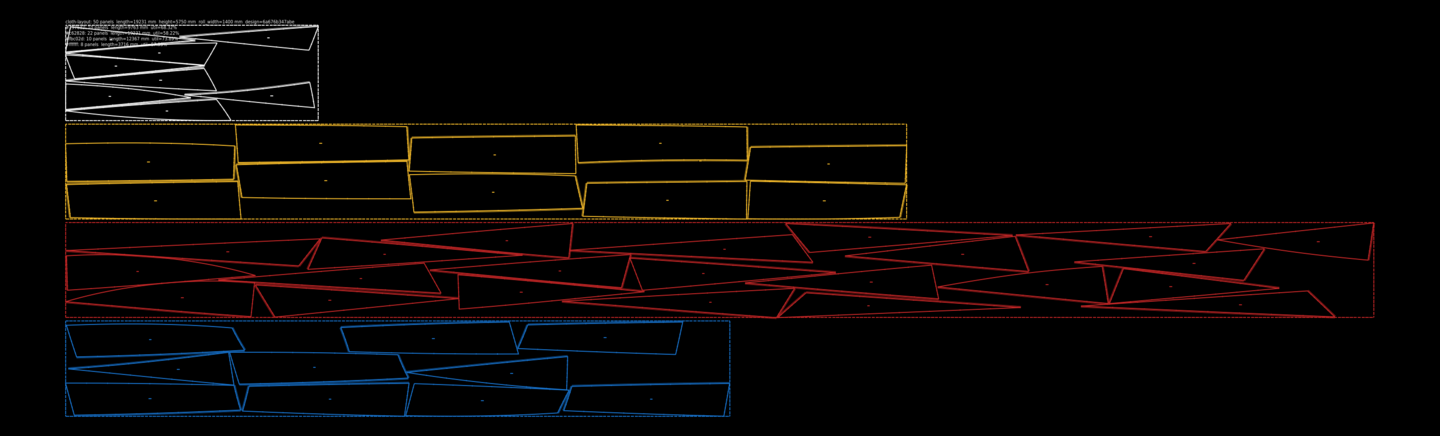
Viewer-toolbar export of the Albin Vega 27 gennaker example in Tri-radial Stripes mode; each colour is nested independently.
- One roll-width strip per colour
- Panels placed within the roll outline
- Separate colour layer
Read the downloaded layout
The browser downloads panels-cloth-layout.dxf. It is a millimetre DXF at full size. Unlike Panel DXF, its coordinates are the actual placements chosen for the cloth layout.
Each colour group has its own DXF layer and roll outline. Colour strips are stacked with a 50 mm space between them in the combined drawing. Within a strip, the file contains the placed panel boundaries, owned seam-allowance lines, match marks, warp marks, panel labels, and summary metadata. A layout with no colour map has one off-white strip.
The file does not include corner reinforcement patterns. Export those separately with Corner Patches DXF.
Verify the roll layout
Confirm millimetre units and layer colours
Open the file without rescaling. If you exported a colour scheme from the panel viewer, confirm that the expected colour layers and strip outlines are present. A File-menu export should have one off-white group.
Read each strip separately
Use the CAD layer list to isolate one colour. Treat each outlined strip as a separate length of cloth; the 50 mm space only separates the strips in the combined drawing.
Check placement and allowance marks
Confirm that every generated panel number appears once, stays inside its roll outline, and carries the expected allowance, match, and warp marks.
Measure before cutting
Check the roll width and a known panel dimension in CAD, then verify the downstream plotter or cutter. The DXF has no printed calibration rectangle.
A long-running export can fail
The File-menu status bar changes to exporting cloth layout — this can take a minute or two… when the action starts. The panel viewer shows Cloth Layout DXF… and pauses the other export buttons. If the calculation queue is full or the operation times out, wait and retry; no usable file was downloaded.